


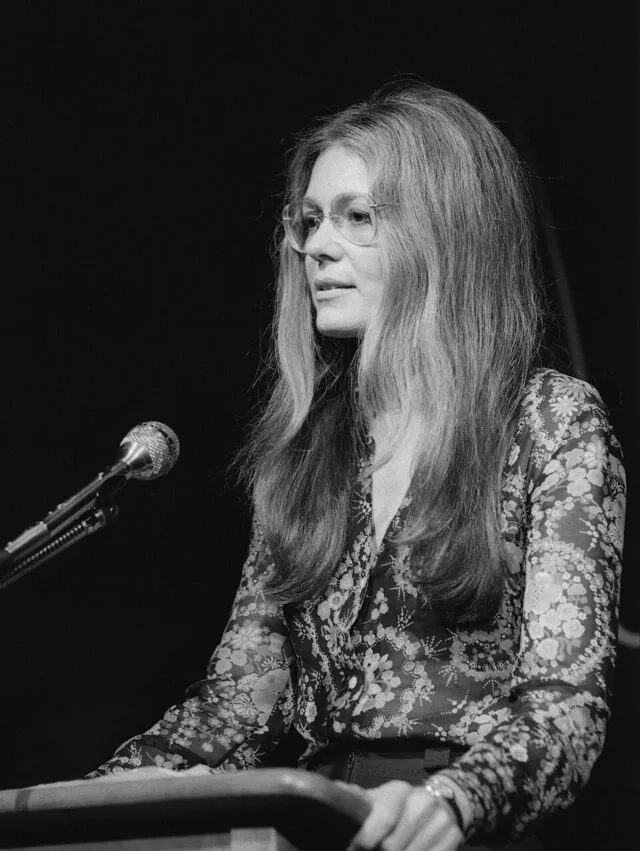
Remembering how India helped shape one of the world’s most influential feminist leaders—and the lessons Yoga Gives Back continues to learn from women creating change within their own communities.
“India made me who I am.” — Gloria Steinem
Read The Juggernaut feature “Gloria Steinem, Made in India,”
As the world mourns the passing of Gloria Steinem at age 92, Yoga Gives Back was deeply moved to discover a chapter of her life that is far less widely known: the transformative years she spent studying and traveling throughout India as a young woman.
A recent article in The Guardian recounts how Steinem arrived in India in 1957 at age 22 on a Chester Bowles fellowship and remained for nearly two years. Decades later, she described the experience as pivotal to the person—and activist—she became. (The Guardian)
What she encountered was not an abstract philosophy. She experienced the realities of poverty and patriarchy, listened intimately to women speak about their lives, and traveled with grassroots organizers influenced by Mahatma Gandhi who were working to heal communities torn apart by violence.
Gloria Steinem spent 18 months in India in 1957 and 1958 that set the trajectory for the rest of her life. She credited those pivotal months with teaching her to listen, to organize from the ground up, and to understand “radical” as going to the root of a problem rather than to its extreme. In 2007, she told two Indian interviewers, “If you want people to listen, you have to listen to them. I believe I learned that in India.” (The Philadelphia Inquirer)
Her connection to India began long before she got there. Her mother and paternal grandmother were Theosophists, or followers of a spiritual movement that borrowed from Hindu and Buddhist thought and treated India as the home of ancient wisdom. While a student at Smith College in the 1950s, Steinem studied with Vera Micheles Dean, a foreign policy scholar who wrote about India and was publicly accused of communist sympathies in 1954. During her junior year in Geneva in 1954-1955, she wrote a research paper on why the Communist Party of India had never become the country’s dominant party.
For Yoga Gives Back, her story feels especially poignant.
Because for nearly two decades, we too have been learning from India that meaningful change begins by listening—and that lasting empowerment grows from within communities.
What Gloria Steinem Learned in India
During her time in India, Steinem lived among students at Miranda House, Delhi University’s women’s college, and traveled extensively throughout the country.
One experience took place in a women-only railway carriage during a long journey across India. Women settled in together with their children and food and began talking freely about marriage, childbirth, contraception, family life, and their everyday experiences.
Years before consciousness-raising circles became a hallmark of the American women’s movement, Steinem was witnessing women discover the power of sharing what had often been regarded as private struggles. She would later recognize the connection between those conversations and the organizing methods she helped build in the United States. (The Guardian)
An even more formative experience came after caste violence erupted in southern India. Steinem joined workers associated with Vinoba Bhave, a leading disciple of Mahatma Gandhi, as they walked between villages seeking to discourage retaliation, counter rumors, and bring people together.
The work centered on something deceptively simple: listen before deciding what another community needs.
Meetings took place beneath trees and in village courtyards. People who had experienced violence were given space to speak. Organizers listened, encouraged dialogue, and sought consensus rather than imposing solutions from outside.
Steinem later connected these experiences directly to the organizing philosophy she carried into the American feminist movement. (The Guardian)
It is an approach grounded in ideas closely aligned with the Gandhian traditions of ahimsa, nonviolence and transformation through collective action rather than domination.
A Lesson Yoga Gives Back Continues to Learn from India
This part of Gloria Steinem’s story resonates deeply with Yoga Gives Back.
When we speak about “giving back” to India, we are not speaking simply about sending funds from one part of the world to another.
Throughout our long-term partnerships with grassroots NGOs in India, the women, girls, social workers, and community leaders themselves have continually taught us what empowerment looks like.
Our role is to listen, collaborate, support, and help expand work that is already taking root within communities.
India’s Influence Reaches Beyond Its Borders
One powerful example is YGB’s Sister Aid program with our NGO partner NISHTHA in rural West Bengal.
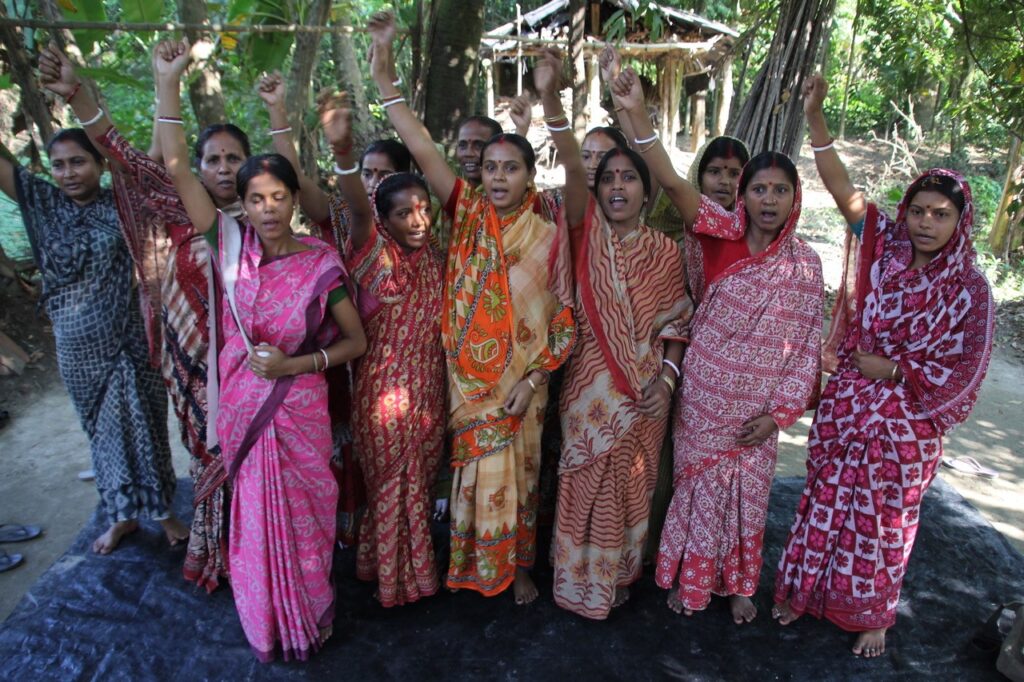
What began in 2011 has grown into a network of 49 groups and 539 women. The groups combine economic opportunity with something equally important: solidarity. Women support one another in building businesses, saving for their daughters’ education, confronting violence, preventing child marriage, and protecting girls at risk of trafficking.
Over 15 years, NISHTHA reports that these Sister Aid groups have helped prevent hundreds of child marriages and trafficking cases and have created community protection networks involving women and men. Their work includes negotiations, rallies, public campaigns, meetings, and direct intervention when another woman or girl is in danger.
This is not empowerment being delivered to women.
This is women empowering one another.
We see the same evolution through our SHE Scholarship for Higher Education program.
Young women who originally joined SHE to continue their own education have become advocates for other girls. SHE participants have formed peer groups, engaged fathers and community leaders, intervened to prevent early marriage and trafficking, helped girls return to school, and created new women’s groups of their own. Over the program’s 13-year history, many graduates have become nurses, teachers, entrepreneurs, professionals, digital service providers, and grassroots leaders.
Recent SHE programs continue this community-based approach through girls’ groups, mothers’ groups and meetings with fathers. These spaces encourage girls and families to discuss education, rights, marriage, safety and opportunity together—turning individual change into collective change.
In this sense, Gloria Steinem’s discovery in India feels remarkably familiar to us:
Listen. Gather. Share experiences. Build strength collectively. Let change grow from the community itself.
From Gloria Steinem to Trudy Goodman
There is another beautiful connection that makes this reflection particularly meaningful for Yoga Gives Back.
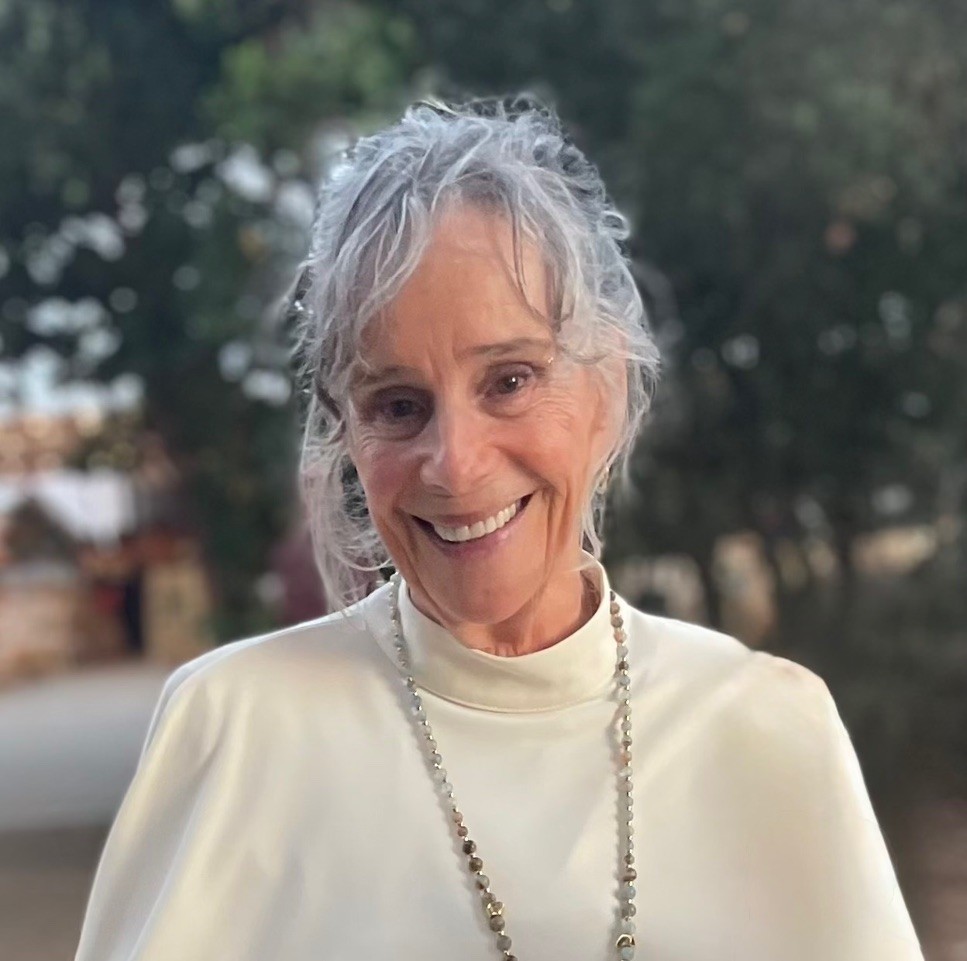 Trudy Goodman, recently shared how deeply Gloria Steinem influenced her own life. YGB will honor Trudy with our Leadership Award at the 19th Anniversary Global Gala this November,
Trudy recalled joining a consciousness-raising group in 1971, during the second wave of feminism that Gloria helped bring into public awareness:
“We sat together and told the truth about our lives. Soon, we understood that what we struggled with individually was part of a world-wide pattern of discrimination.”
That experience echoes, strikingly, the conversations Steinem had witnessed among women in India years earlier.
Trudy also remembered hearing Gloria speak much later in life to busloads of high school girls from across Los Angeles—still encouraging a new generation of young women.
Reflecting on Gloria’s legacy, Trudy wrote:
“May each of us discover our own way of helping to create the future we long for.”
That feels like a message worth carrying forward.
India Gives Us So Much More Than Yoga
Yoga Gives Back was founded from a simple feeling of gratitude.
India gave the world the profound traditions of yoga that millions of us practice today. Founder, Kayoko Mitsumatsu, feels that gratitude should become action. Karma Yoga and seva, service offered for the benefit of others
But over the years, our understanding of “giving back” has deepened.
India continues to give us lessons.
We learn from women who turn small economic opportunities into networks of mutual protection. From girls who receive an education and then use it to defend another girl’s right to stay in school. And from grassroots social workers who understand that changing one life often means engaging an entire family and community.
As we reflect on Gloria Steinem’s extraordinary life, we are reminded that India helped shape the activism of one of the most influential feminists of our time as well. Her connection to India is another powerful example of how learning, compassion, and action can cross borders and generations.
This is the circulation of gratitude that lies at the heart of Yoga Gives Back.
We receive, we learn, we act, and what we receive becomes something we can offer again to others.
Creating the Future We Long For
Gloria Steinem’s legacy reaches across generations. From the women she listened to in India in the 1950s, to the consciousness-raising groups of the 1970s. To leaders such as Trudy Goodman, to young women finding their own voices today.
Her journey reminds us that profound social change rarely begins with one person arriving with all the answers.
It often begins when people sit together.
When someone listens.
When an individual struggle becomes a shared understanding.
And when that understanding becomes action.
At Yoga Gives Back, we remain grateful to India for continuing to show us what that can mean.
Join Us in Gratitude in Action
Join us at Yoga Gives Back’s 19th Anniversary Global Gala on Sunday, November 15, 2026, at Sofitel Beverly Hills, where we will honor Trudy Goodman with the YGB Leadership Award and celebrate the power of community, service, and gratitude in action.
Support Yoga Gives Back and help expand education and economic opportunity for women and children in India.


