


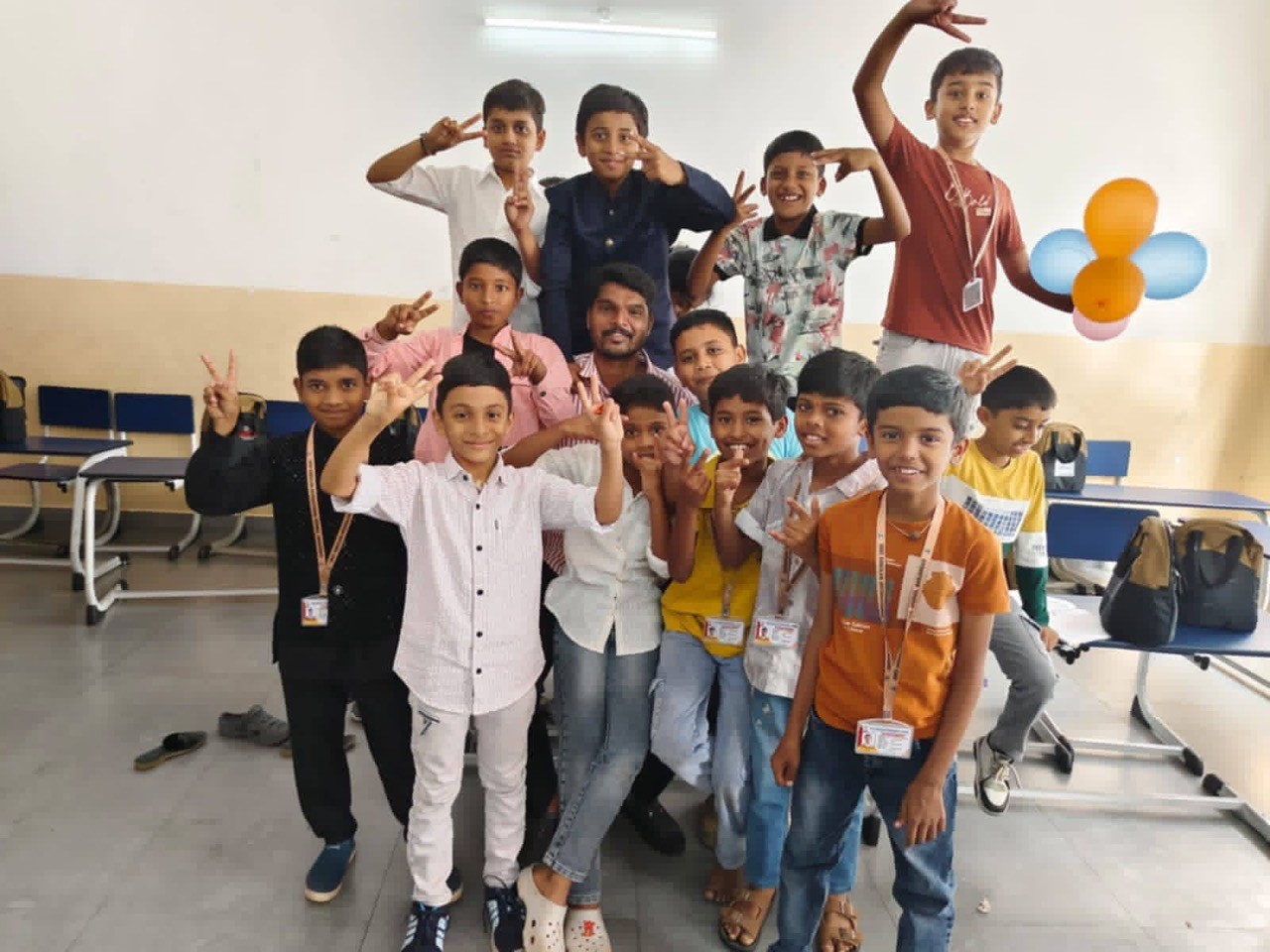
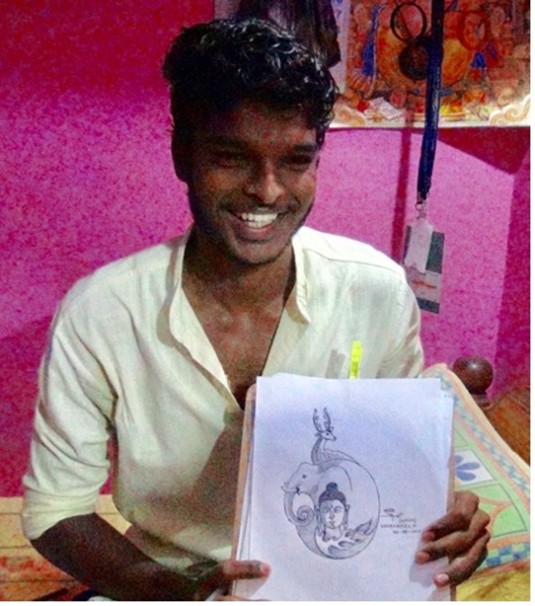
 When Yoga Gives Back first met Nagaraju P. in Chamarajanagar, Karnataka, he was a young SHE scholarship student with a quiet but unmistakable gift.
He came from a very poor family in a village outside Mysore. His father worked as a day laborer, earning a modest wage with little formal education, while his mother cared for the home. Like many parents facing economic hardship, his father hoped Nagaraju would pursue the stability of a government job. But even then, Nagaraju’s drawings revealed another path—one filled with imagination, discipline, and a rare ability to observe the world deeply.
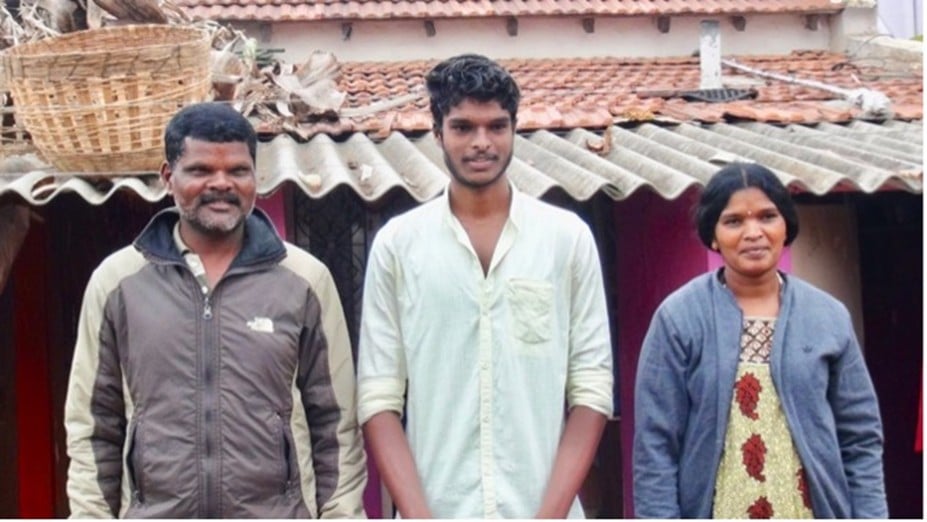
In 2016, during a visit to his home, Yoga Gives Back Founder Kayoko Mitsumatsu saw his drawings in person after Professor Jayadev of Deenabandhu Trust had shared them by email. What she found was not simply “talent,” but a young person using art to interpret life around him. Through YGB’s SHE Scholarship for Higher Education, Nagaraj was able to continue his college education in Mysore—an opportunity that helped keep the door open for his dream.
A Dream Begins: The Nirvana Project
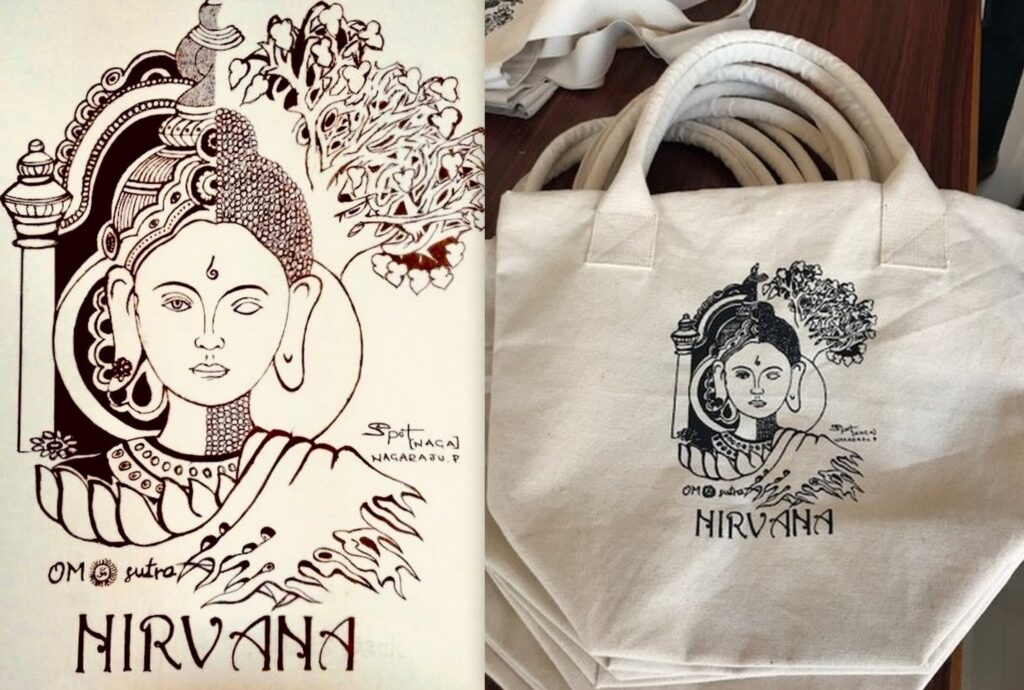
In 2017, Kayoko introduced Nagaraj’s artwork to Jyoti Jaiswal, founder of Om Sutra, an online yoga accessories company based in New York. Jyoti was deeply moved by his work and agreed to create bags featuring his design. This collaboration became known as the “Nirvana Project,” inspired by Nagaraju’s artistic transformation and his journey toward his dream.
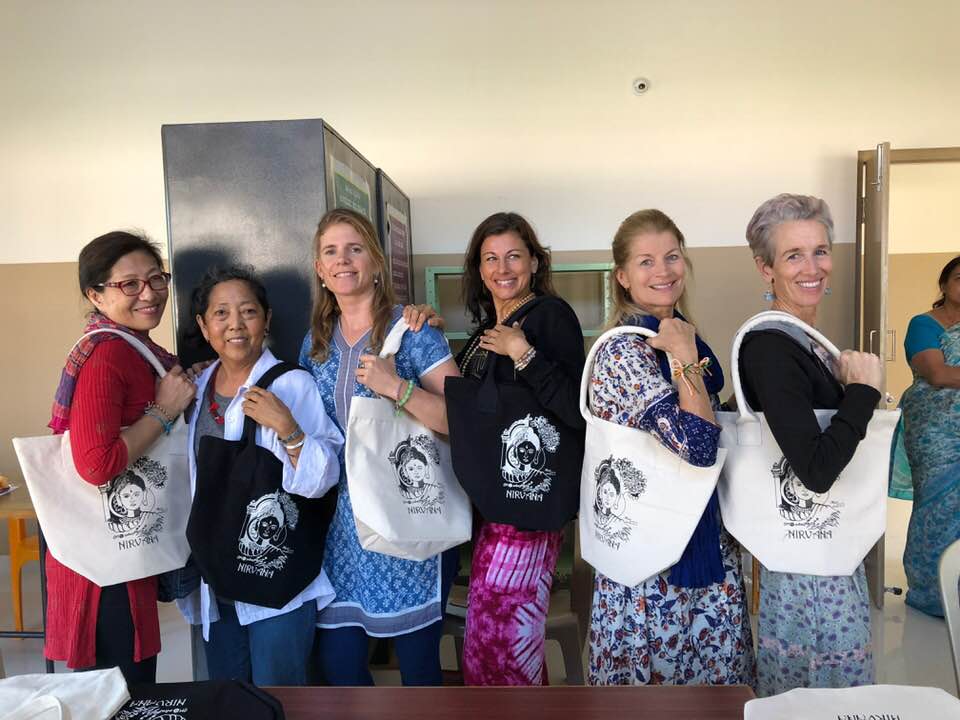
His design—depicting the transformation of King Siddhartha into the enlightened state of Lord Buddha—became more than a product image. It became a symbol of what education, encouragement, and opportunity can awaken in one young life. At the time, Nagaraju was still unsure whether he could pursue art seriously. But when Kayoko met him again, she learned that he had decided to continue. His gratitude was clear, but even more moving was his wish to establish himself as an artist so he could help poor children in his own community.
That desire to give back is one of the most powerful expressions of YGB’s work: when a young person receives support and turns it into purpose.
Art as Observation, Not Decoration
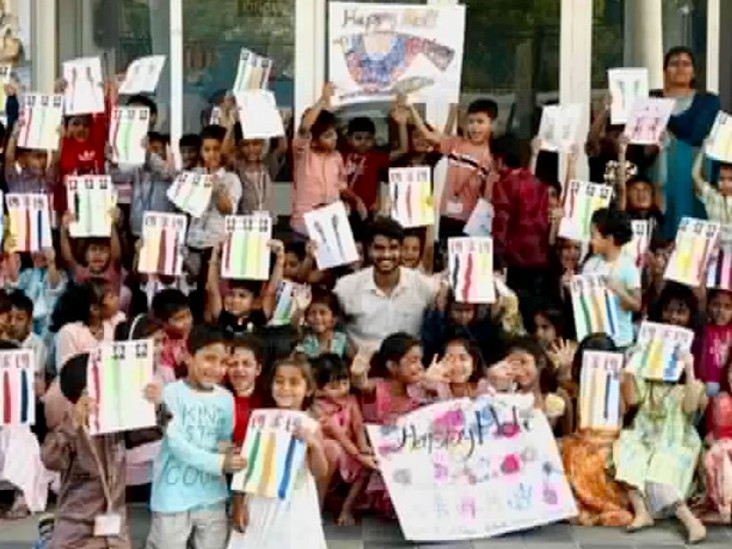
Today, Nagaraj is an art teacher. His journey has come full circle: from a student whose own education was supported, to an artist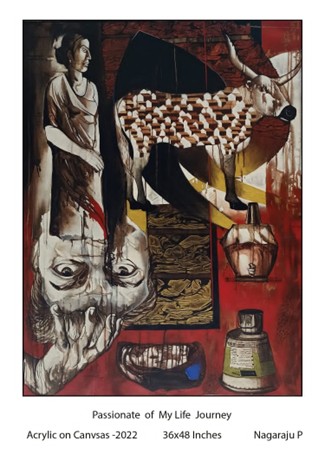 helping others see, imagine, and express.
What makes Nagaraj’s work so powerful is not only his skill, but his subtlety. His drawings and paintings are not loud statements. They do not shout. Instead, they ask us to look more closely.
In his recent artwork reflecting on the COVID period, Nagaraj captures the disorder, displacement, and hardship experienced especially by middle-class and lower-income communities. Houses appear as symbols of people forced to return home without financial security, while other details reflect the experience of those stranded in hostels and guest accommodations, separated from their families and familiar surroundings. Objects such as a bucket, mug, bag, and wardrobe become part of the story—not as decoration, but as evidence of lived experience.
Through these quiet details, Nagaraj reminds us that the pandemic was not one single story. It was millions of personal stories: workers walking home, students trapped far from family, families losing income, and people already living with hardship pushed even closer to the edge.
Seeing the Social Issues Others Overlook
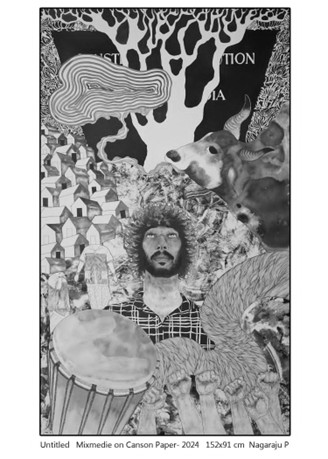 Nagaraj’s artwork also addresses caste-related issues with a careful and layered visual language.
In one painting, he places himself at the center of the composition, surrounded by symbols drawn from his own observations. The Indian Constitution appears in the background, representing law, rights, and guiding principles. A tree above him becomes a symbol of how vast and deeply rooted caste issues remain. Houses in the upper section reflect residential patterns in which marginalized caste communities are often pushed to the edges, living outside the main city or in peripheral areas.
Two women above a drum represent sanitation workers, many of whom come from historically marginalized communities. The drum itself, made from animal skin, becomes another symbol of how ideas of purity and impurity continue to shape social attitudes.
The cow appears in both works as a complex symbol. In Nagaraj’s own explanation, it represents caste-related tensions and taboos that persist in Indian society. Rather than presenting these themes directly or harshly, he weaves them into the visual world with restraint. His art invites the viewer to sit with discomfort, to notice what is often ignored, and to recognize how deeply social structures affect everyday life.
This is the strength of Nagaraj’s artistic voice. He sees what is hidden in plain sight.
The Power of Education to Unlock a Life
Nagaraj’s story is also a reminder of why YGB’s SHE Scholarship for Higher Education exists.
Education is not only about completing a degree. It is about allowing a young person to discover who they are, what they are capable of, and how they can contribute to the world. For some students, that path leads to medicine, engineering, teaching, law, or business. For Nagaraj, it led to art—and then to teaching art.
When YGB first shared his story in 2018, Nagaraj’s dream was just beginning. His artwork had traveled from Chamarajanagar to New York through the Nirvana Project, and his future was still unfolding. Kayoko wrote then that “no dream is too small or too big to pursue,” and that YGB would continue to follow his story year after year.
Now, years later, we see the deeper meaning of that promise.
Nagaraj did not simply become an artist. He became an artist who teaches. He became an observer of society. He became someone who uses visual language to speak about poverty, caste, migration, dignity, and resilience. His journey shows how one scholarship can open more than one door—it can help a young person find the confidence to become a voice for others.
Gratitude in Action
At Yoga Gives Back, we often say that our mission is not just to send support where there is need. We are creating an eternal circulation of gratitude.
Nagaraj’s journey is one beautiful example of that circulation. Support from the global yoga community helped him continue his education. His education helped him pursue his art. His art now helps others see social realities with greater compassion and awareness. And as a teacher, he is helping the next generation develop their own eyes, hands, and voices.
This is gratitude in action.
From a simple home in Chamarajanagar to the creation of the Nirvana Project, from student drawings to socially conscious paintings, from scholarship recipient to art teacher—Nagaraj’s journey reminds us what becomes possible when a young person’s talent is seen, supported, and allowed to grow.
Please join us in supporting more students like Nagaraj through Yoga Gives Back’s SHE Scholarship for Higher Education.
Donate to support education in India
Read more stories from Yoga Gives Back


